
Structure Before Intelligence
An AI contract tool could parse a contract but couldn't help you find one. I led the design that put an information architecture underneath the intelligence.

AT&T’s platform and data are proprietary. All screens recreated from the originals — branding removed, data synthetic.
Role
Lead Designer, the sole designer on an engineering-led build.
Scope
AI contract repository for procurement, legal, and third-party risk teams.
Outcome
Contract ID as primary key made the corpus findable. 3 inconsistent patterns → 1. Shared direction where none existed.
THE PROBLEM
Engineered as a platform, never built as a product
I joined after engineering had already shipped a working platform with dense nested tables, two tabs doing the same thing, and no defined search criteria. Everything worked, and almost none of it made sense to a user. Getting the team to see that gap was the real engagement.

Tiles divided by logic that never held — same data behind different tiles, no way to learn the pattern.
THE APPROACH
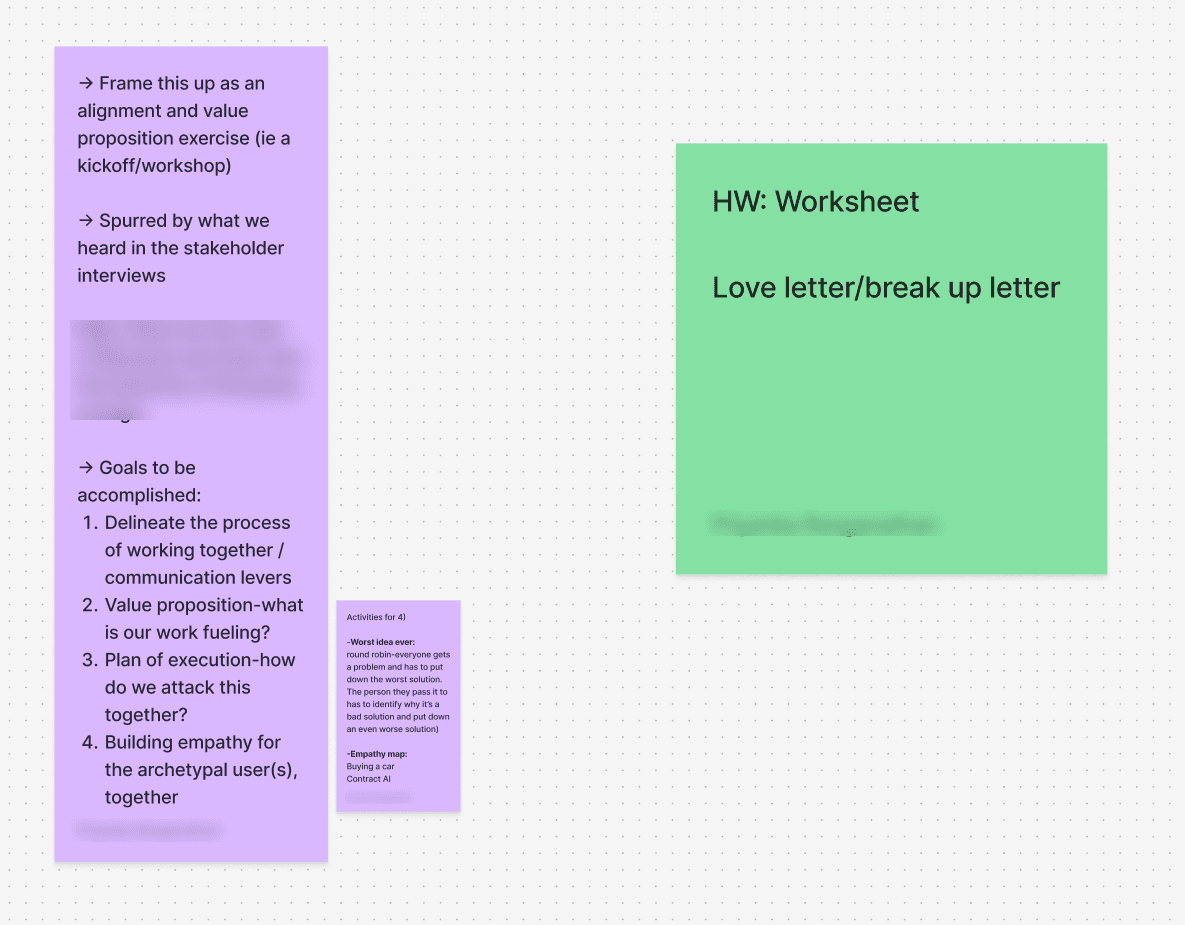
An alignment workshop instead of a design review
Stakeholder interviews showed the confusion in the UI was a symptom — nobody building the product shared a definition of what it was or who it was for. A round-robin critique exercise and an empathy-mapping session got the team reasoning about real users instead of the backlog.



THE PIVOT
Findability before intelligence
Contract ID as the way in
Search by ID, vendor, or plain language. This is the entry point the corpus never had before — everything else in Contract AI depends on it.

A cited answer, not a guess
Every answer links back to the exact clause and page it came from, so nothing has to be taken on faith.

One pattern, not three
A single side-by-side comparison, replacing three inconsistent versions of Compare that used to live across separate tools.
We tried…
The existing build put AI on top of an unstructured pile — nested tables, no defined search criteria, features named things that meant nothing.
Why it failed…
You cannot ask a question of a corpus you cannot navigate — nobody could find the contract they needed to query in the first place.
Instead…
Made contract ID the primary key so the corpus became findable, then scoped the AI to a selected contract — summary, cited Q&A, and side-by-side comparison.
AI cannot compensate for missing information architecture. You cannot ask questions of a contract corpus you cannot navigate.
THE PROOF
Outcomes
AI scoped to a selected contract, every answer traceable to its source page
Contract ID
Established as the primary key. The corpus became findable for the first time
3 → 1
One cross-product pattern replaced three inconsistent implementations of Compare
Requirements defined where none existed before
A reactive feature team aligned on a shared, user-grounded direction


