
Designing trust into an AI platform
Finance professionals won't act on an AI they can't see the reasoning behind. I led the design program that made one trustworthy enough to use.

AT&T’s platform and data are proprietary. All screens recreated from the originals — branding removed, data synthetic.
Role
Design Program Lead, leading 4 designers across 5 modules
Scope
AI-native finance ops hub, built for analysts, auditors, and controllers
Outcome
Reversed platform direction from tool-first to data-first. Shared design-system foundation shipped across all 5 modules
THE PROBLEM
Five tools, no shared truth
Analysts reconciled numbers across Excel, Power BI, and legacy reporting — none of which shared context, so nothing could prove its own numbers. The AI-native platform meant to fix this had been rushed to launch instead: built to impress, not to fit how analysts actually work.
In finance, an answer you can't defend is worthless.
The AI gave one-word verdicts with no reasoning shown. Analysts couldn't stand behind the numbers to their own leadership, so they went back to Excel.
THE PIVOT
The research that flipped the direction

Tool-first: MVP 1
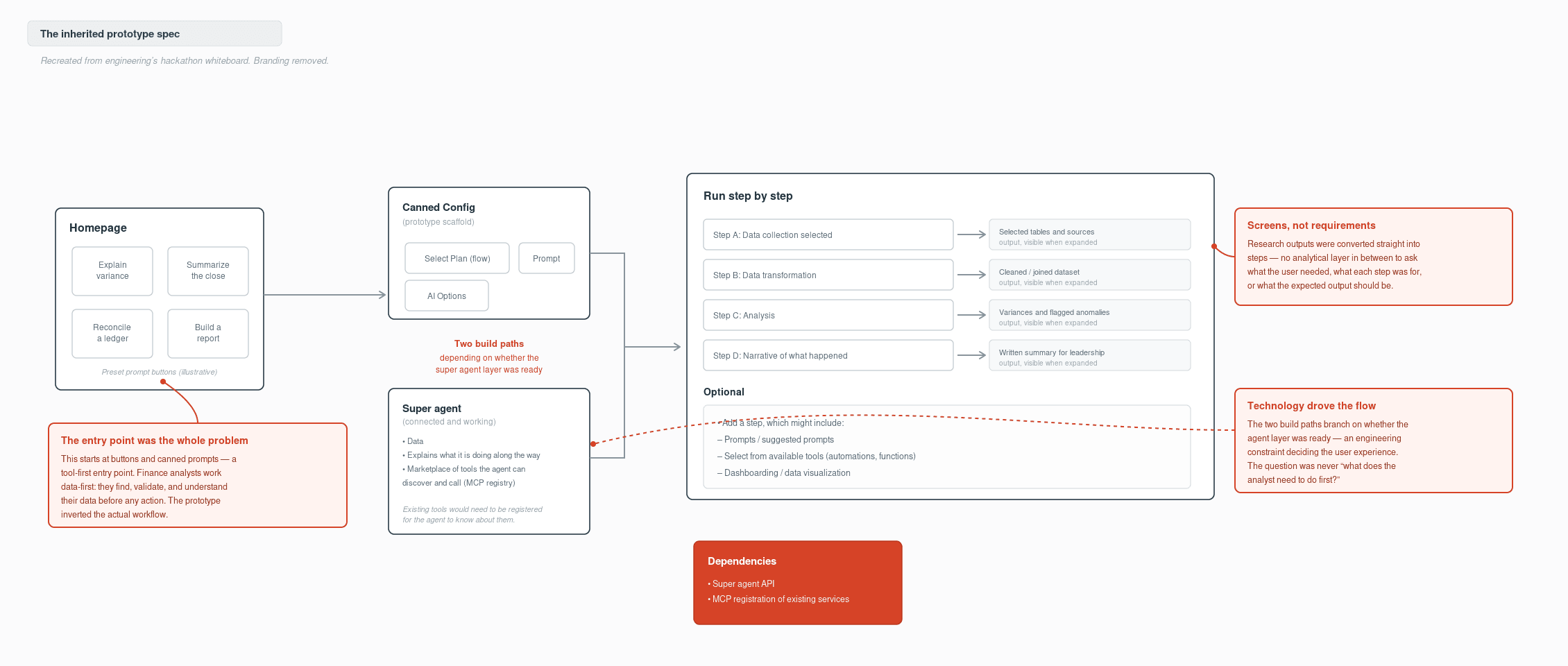
A polished version of the inherited prototype: still asks what to build before showing any data.

Data-first: Research-driven MVP 2
The redesign that followed: analysts browse and verify the data before any analysis begins.
We tried…
MVP 1 shipped tool-first — open on a prompt box, let the AI answer.
Why it failed…
A mixed-method study with 18 finance analysts showed why: they couldn't trust an answer without seeing the data behind it, so they verified everything in Excel anyway — the AI added a step instead of removing one.
Instead…
Rebuilt the entry point data-first — browse and verify the data, then analyze. That single insight reversed MVP 2's direction across the platform.
THE PROGRAM
A program, not a screen
Five modules, four designers, multiple engineering teams. My job was the connective tissue: a shared design system, a direct line to the finance VP, and cover for my team to solve the right problems instead of defending their right to solve them.
Vision and connective tissue across all five modules. The deepest hands-on work was the Data Sandbox.
THE PROOF
Outcomes
Research reversed engineering's direction
Tool-first → data-first, now the design foundation MVP 2 runs on
Shared design system + component library
Shipped across all 5 modules
Live and scaling
Sandbox MVP 1 live with an active user base; targeting 90% deviation-detection accuracy as a 2H 2026 goal


